



Search

Please enter a keyword or what you are looking for in the field below to search.

alt
Search result
There is no result for your search, please check again.
    alt alt alt alt
    alt alt alt alt
    alt

    From "Connected Equipment" to "Data-Driven Decisions":The Next Step for AI Smart Factories

    Equipment is connected and data is being collected, so why are managers still firefighting every day? This article breaks down the three biggest dilemmas of “visible but unusable” manufacturing data, and explains how AI can truly reduce shop-floor workload through anomaly alerts, scheduling recommendations, and automated reporting.

    Scroll

    In our last article, we discussed how automation is about executing actions, while smart manufacturing is about making decisions, and how getting equipment data to flow is the first step toward a smarter factory.

    Yet many factories, after connecting their equipment and installing dashboards, run into a puzzling situation: they have the data and the reports, but managers’ workloads haven’t shrunk. They still walk the production lines first thing in the morning, still hold afternoon meetings to go over the numbers, and when an anomaly occurs, they still rely on phone calls and LINE groups to pass the word along, layer by layer.

    The data is connected, but decisions are not yet moving. This is precisely the “last mile” where many factories get stuck on the road to AI-driven smart manufacturing.
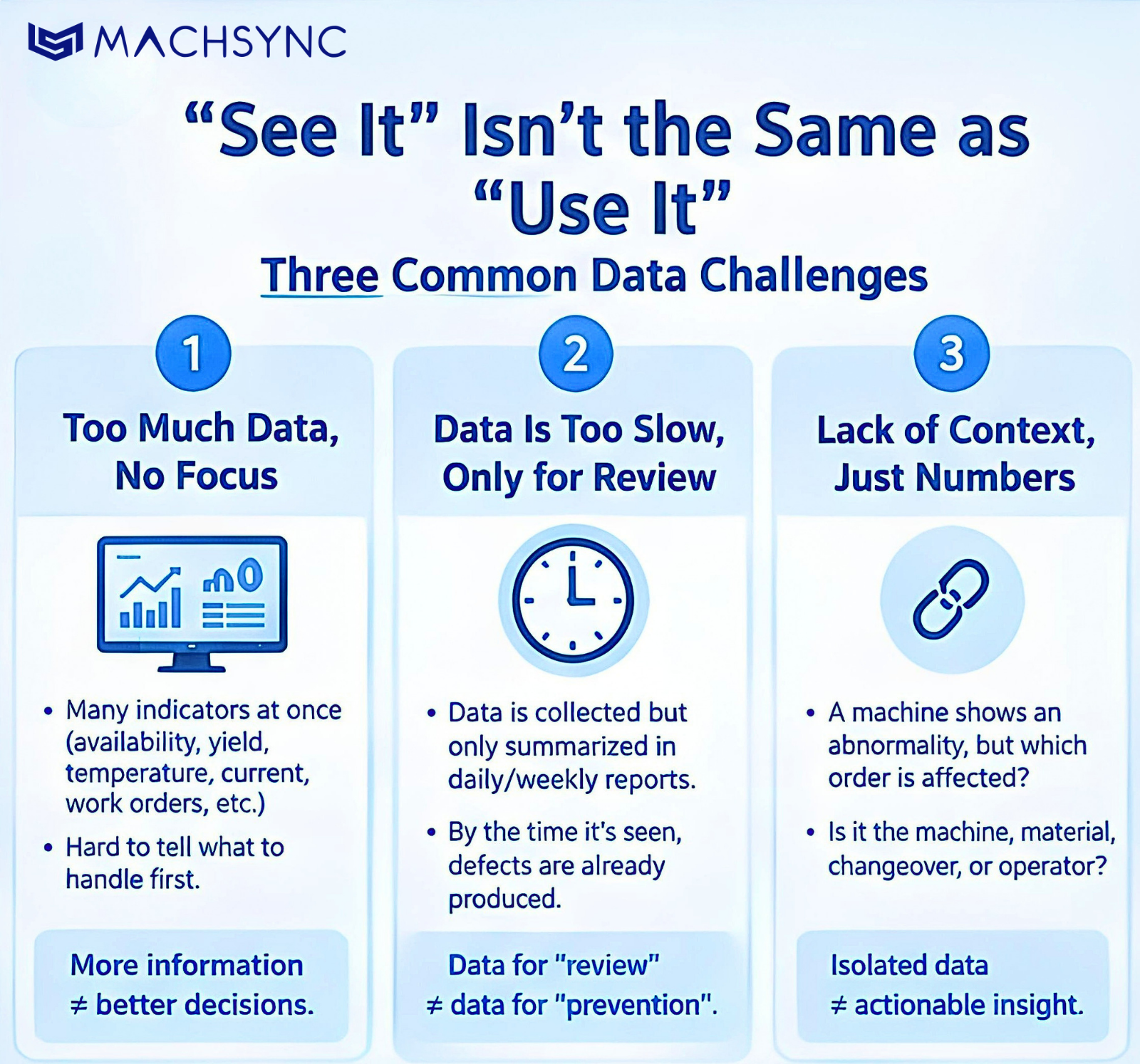
    "Visible" Does Not Mean "Usable" : Three Common Data Dilemmas

    1. Too much data, no clear priority.

    Dozens of metrics flash on the screen at once: utilization rate, yield, temperature, current, work order progress. Each one looks important, yet no one can say clearly, “What is the first thing we should deal with right now?” The more information there is, the heavier the burden of judgment becomes.


    2. Data arrives too late, so it only supports after-the-fact reviews.

    The data is collected, but it isn’t compiled until the daily or weekly report. No one knows when an anomaly occurs, and by the time the report appears, an entire batch of defective products has already been made. Data like this can only be used for “post-mortems,” not for “prevention.”


    3. Data lacks context: knowing what happened, but not why.

    The system shows that a machine is abnormal, but which order does this machine affect? Is the problem with the equipment itself, or is it caused by raw materials, changeovers, or operator handling? Without cross-system connections, data is just a collection of isolated numbers that cannot be directly translated into action.

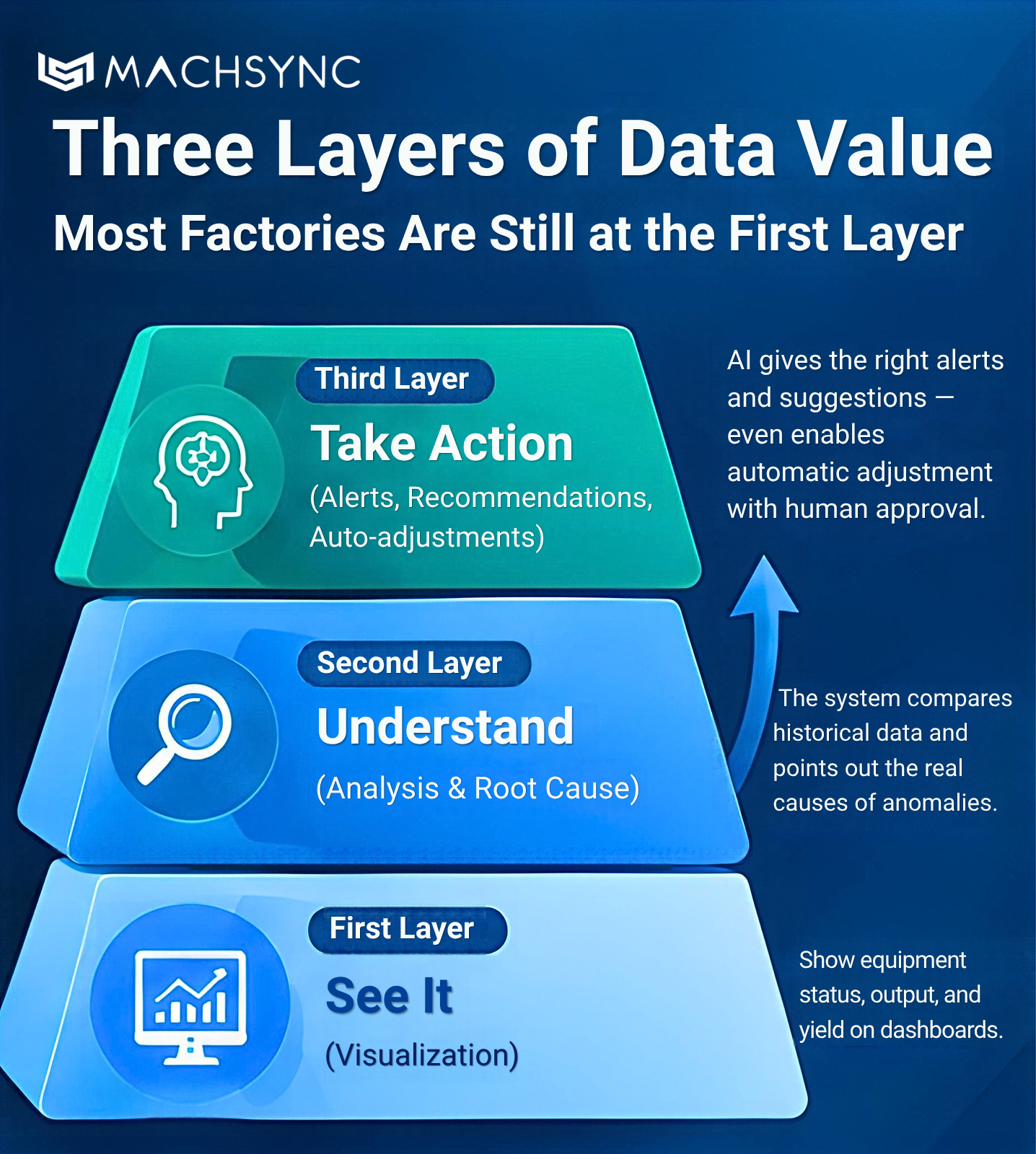
    Three Levels of Data Value: Most Factories Stop at the First

    Level 1: Visible (Visualization)

    Presenting equipment status, output, and yield on a dashboard.


    Level 2: Understandable (Analysis and Root-Cause Finding)

    The system can compare against historical data and identify which factors are associated with an anomaly.


    Level 3: Actionable (Early Warning, Recommendations, Automatic Adjustment)

    The system proactively raises alerts, and may even propose schedule or parameter adjustments for a person to confirm and execute.


    Most factories today remain at Level 1. The place where AI can truly deliver value is Levels 2 and 3, which means turning “people watching data” into “data finding people.”

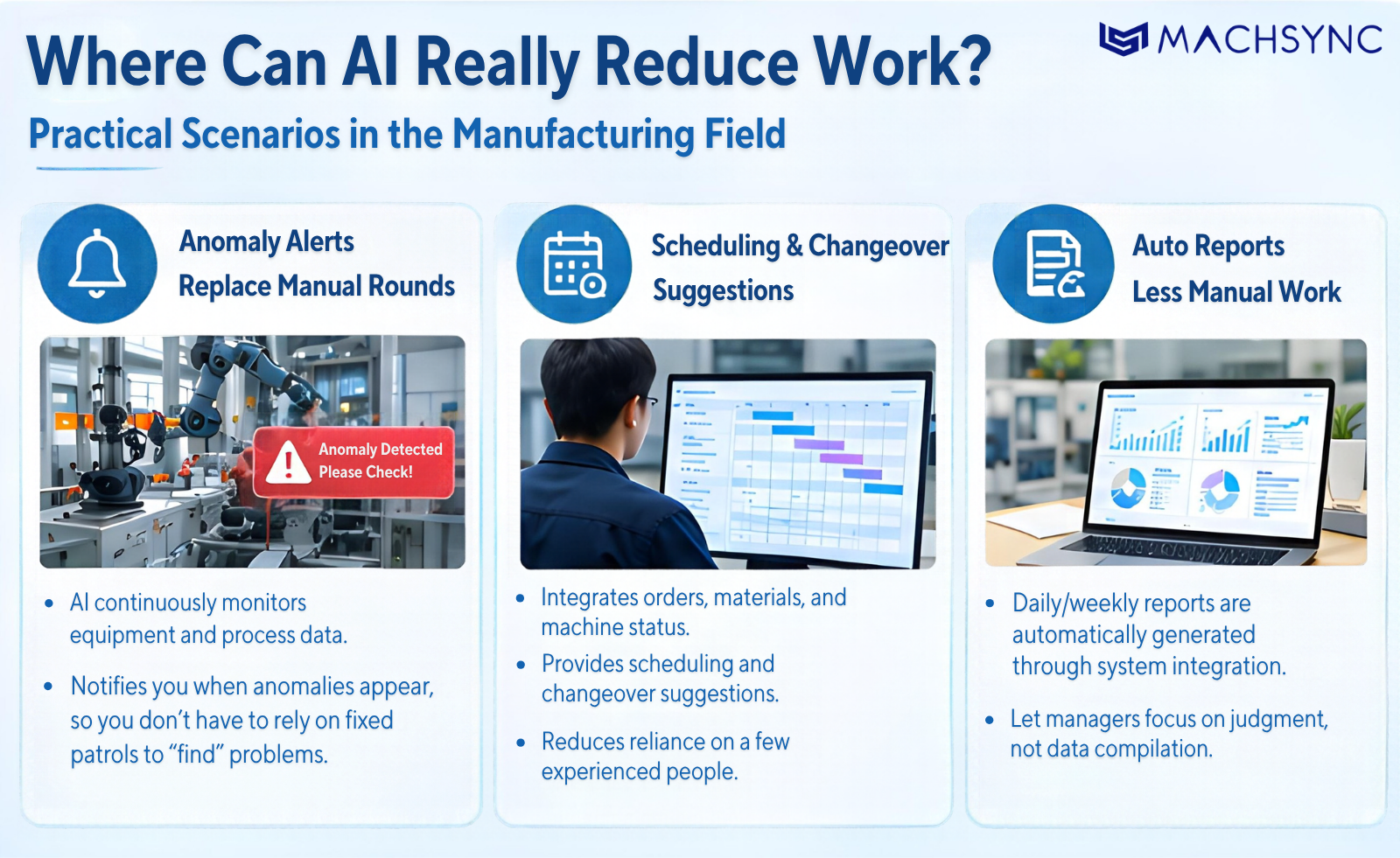
    Where Can AI Truly Reduce Workload?

    Back to the question at hand: with so much AI in use, has the work actually decreased? The answer depends on where AI is placed. Here are the scenarios on the shop floor that are most common and where results are easiest to see:

    • Anomaly alerts replace manual line patrols
      AI continuously monitors equipment and process data and proactively sends notifications when early signs of an anomaly appear, so managers no longer have to rely on scheduled walk-throughs to “discover” problems.
    • Scheduling and changeover recommendations reduce dependence on veteran technicians’ experience
      The system takes orders, materials, and machine status into account to offer scheduling and changeover suggestions, turning experience into transferable knowledge rather than something that lives only in a few people’s heads.
    • Automated report compilation reduces manual stitching
      Daily and weekly reports that once took half a day to put together are now pulled together and produced automatically by the system, so managers can spend their time on judgment rather than on organizing figures.

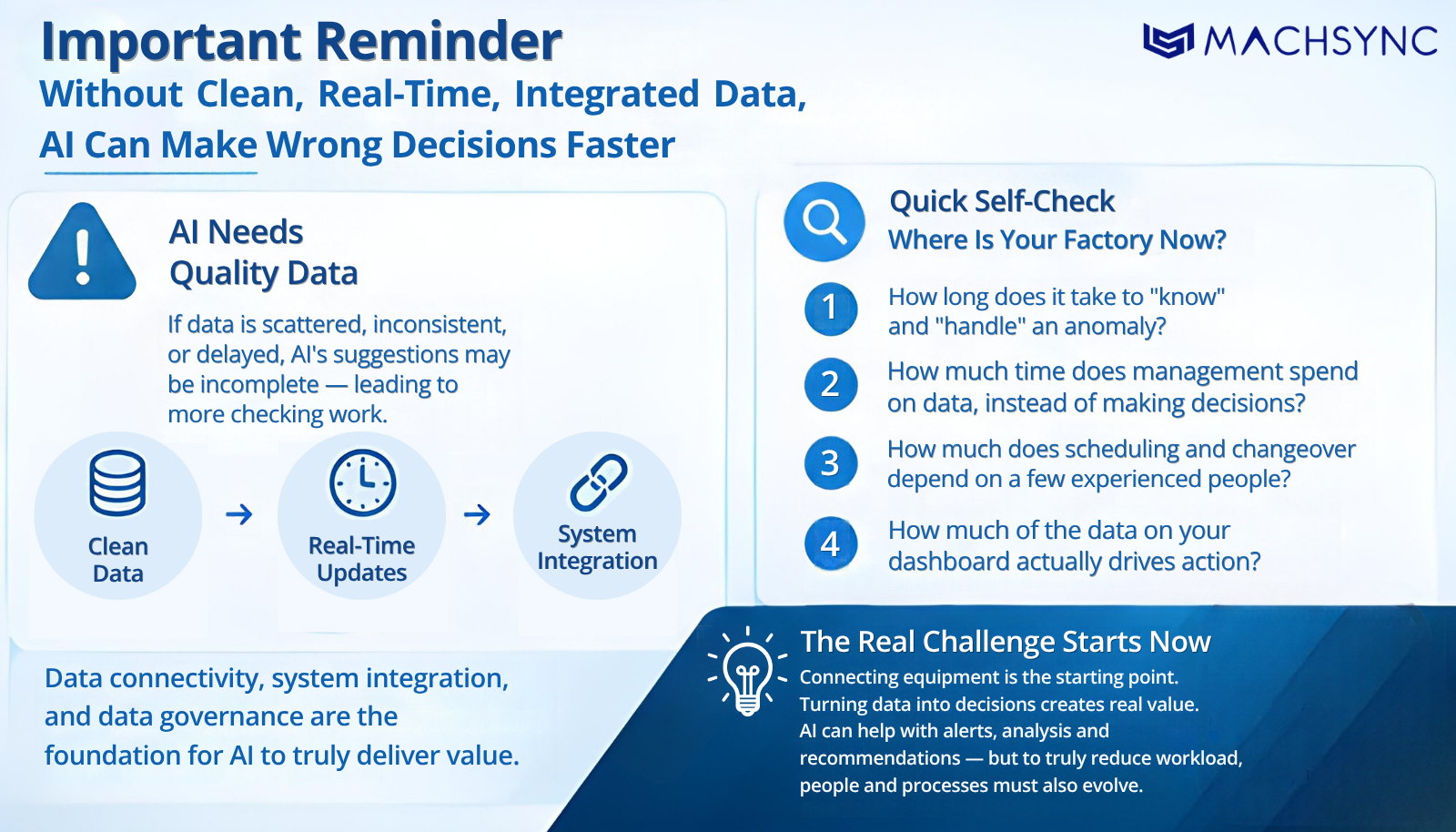
    Don't Overlook the Prerequisite: Without Clean, Real-Time, Integrated Data, AI Just Makes Wrong Decisions Faster

    AI is not magic that reduces work the moment it is installed. If the underlying data is scattered across different systems, inconsistent in format, and delayed in updates, the recommendations AI produces will be built on incomplete information. This only adds another burden to the shop floor: the work of verifying “whether we should trust it or not.”

    This echoes the core point of the previous article: first get the data flowing, then talk about making the data smarter. Equipment connectivity, system integration, and data governance are the foundation on which AI can truly work.

    Which Level Is Your Factory At Right Now?

    Use the following questions for a quick self-assessment:

     • After an anomaly occurs, how long does it take us to know about it? And how long to deal with it?

     • How much time do managers spend each day compiling numbers instead of making decisions?

     • How much of the shop floor's scheduling and changeover judgment depends on a few senior employees?

     • How much of the data on the dashboard actually leads to action?


    If your answers give you pause, your factory may be stuck between "being able to see" and "being able to act," and that is exactly where the next step is most worth investing.

    Once the Data Is Connected, the Real Challenge Begins

    Connecting equipment is the starting point of a smart factory; letting data drive decisions is where value begins. AI can help with early warnings, analysis, and recommendations, but for the workload to truly decrease, there is one more crucial piece of homework: have people and processes been upgraded together?


    In the other article: Don't Let AI Become One More Step. Three Organizational Challenges in Making Smart Manufacturing Work, we will look at this from the perspective of organization and process: why, even after adopting systems and AI, the workload on the shop floor still hasn’t dropped, and how to redesign work so that adoption truly takes hold.

    Sources: Public domain references

    Some visual content on this page was created or edited with the assistance of generative AI.

    This article is original content created by Machsync. It may not be used for commercial purposes or distributed, shared, or sold in any form. Unauthorized reproduction, excerpting, copying, or use in any visual format is strictly prohibited. 

    For reprint or licensing inquiries, please contact Machsync.

    ﹌﹌﹌﹌﹌﹌﹌﹌﹌﹌﹌﹌﹌﹌﹌

    📬 Get in Touch with Machsync

    📍 2F., No. 38, Keya Rd., Daya Dist. Taichung City, Taiwan

    📞 +886-4-2473-6883

    ✉️ admin@machsync.ai